
Carriage-house and farmhouse garage door styles: what's selling on the surrounding region
BSD Garage Door
Why carriage-house styles have returned to the surrounding region
Carriage-house garage doors fell out of fashion in the mid-twentieth century when mass-produced sectional steel panels became the default residential standard. The appeal of that era was uniformity and cost, and for decades builders treated the garage door as a purely functional component. What is happening now on the surrounding region — in Sherborn, Dover, Medfield, Holliston, and comparable communities — is a correction to that era. Homeowners renovating colonials, federals, capes, and contemporary farmhouses increasingly treat the garage door as a primary facade element, and carriage-house styling has become the dominant choice for homes where visual character matters.
The architectural logic is sound. A carriage-house door evokes the proportions and surface rhythm of hinged barn doors without requiring the mechanical complexity of doors that actually swing outward. The raised panel geometry, the z-brace overlay, the divided-light windows — all of these details read as historically consistent with the the Northeast vernacular that defines the region's residential character. On a colonial or federal-style home, a well-chosen carriage-house door reinforces the architecture in a way that a flush steel panel or a simple raised-panel contemporary door never can.
The market data on the surrounding region reflects this shift clearly. In communities where the median home price supports renovation investment at the $3,000 to $6,000 door range, carriage-house styles now account for a substantial share of replacement door orders on existing homes. New construction in the Sherborn and Dover price tier has standardized on carriage-house styling for anything above the entry-level build specification. The question for most homeowners is no longer whether to choose carriage-house styling, but which of the available material and construction options actually holds up over time in the MA climate.
True divided-light versus simulated overlay panels: understanding what you are buying
The most consequential design decision within the carriage-house category is whether the window panes in the door are true divided lights or simulated panels. True divided-light windows use individual glass panes separated by real muntins — the vertical and horizontal dividers between panes. Simulated divided lights use a single glass pane with a decorative grille applied to one or both sides to create the visual impression of divided panes. The distinction matters for appearance and for maintenance over time.
True divided-light windows on a residential garage door produce a shadow line and visual depth that simulated grilles cannot replicate when viewed at close range or in direct sunlight. The individual panes catch light differently from their neighbors because the slight variation in glass thickness and angle creates a subtle prismatic effect. This is what makes a true divided-light door look like a period piece rather than a reproduction. The tradeoff is that true divided lights are more expensive to produce, require individual pane replacement if one pane cracks, and are available from fewer manufacturers at the residential price tier.
Simulated divided lights have improved substantially in recent years. The highest-quality simulated-light systems use SDL (simulated divided lite) bars that are bonded to both the interior and exterior glass surfaces, producing a shadow line that reads convincingly from street distance. At viewing distances of ten feet or more — which is most of how a garage door is experienced from the street — a quality SDL door is visually close to a true divided-light version. At close range, the difference is clear. For the majority of the surrounding region homeowners, SDL is the practical choice, and the gap in visual quality relative to true divided lights has narrowed enough that the premium for true divided lights is primarily justified on historically sensitive renovations or very high-budget builds.
Material options: wood, wood-look composite, and steel with overlay
Carriage-house styling is available across three primary material categories, and each makes a different set of promises about appearance, maintenance, and longevity in the the Northeast climate. Understanding those promises clearly prevents the disappointment that comes from choosing a material based on how it looks in a showroom photograph rather than how it performs after five MA winters.
Real wood doors — typically built from hemlock, cedar, redwood, or Meranti mahogany — offer a warmth and surface depth that no synthetic material fully replicates. The grain, the slight variations in panel color, and the visual weight of a solid or solid-core wood door are genuinely different from any composite or steel alternative when viewed in natural light. The problem in the MA climate is well-documented: wood swells and contracts with moisture and temperature changes, and on a sectional door with multiple panels the cumulative movement across sections creates fit and finish issues over time. Panel joints that are tight in July may gap in January. Finish maintenance is also a recurring commitment — a high-quality exterior paint or stain on a wood door requires recoating every three to five years in a humid coastal climate, and skipping a maintenance cycle accelerates degradation at the panel edges and bottom rail.
Wood-look composite doors — built from a medium-density fiberboard or polymer-composite core with an embossed wood-grain surface — address the dimensional stability problem. Composite panels do not swell or shrink with humidity cycles the way real wood does, which means the fit and finish remain consistent across seasons. The wood-grain embossing on current-generation composite doors is convincing at normal viewing distances, and the material accepts paint finishes that hold up comparably to real wood. The limitation is at close range: the grain pattern is clearly manufactured rather than organic, and the panels lack the surface depth of real wood. For homeowners who want the carriage-house aesthetic with predictable maintenance requirements, composite is the most practical choice in this climate.
Steel-with-overlay doors combine a standard insulated steel panel construction with decorative wood or composite overlays applied to the face to create the carriage-house visual effect. The result is a door with the thermal performance and structural rigidity of an insulated steel panel plus carriage-house surface detailing. The tradeoff is that the applied overlays are not structural — they are decorative elements bonded to the steel face — and the bond can degrade over time if moisture penetrates at the overlay edges. Quality steel-with-overlay doors from established manufacturers address this with integrated flush trim at all overlay perimeters, which prevents moisture infiltration. This category offers the best overall durability and insulation value for a carriage-house appearance, and it occupies the middle of the price range between bare insulated steel and true wood.
- Real wood: richest appearance; highest maintenance commitment in the Northeast humidity; best for historically sensitive renovations with a maintenance plan in place
- Wood-look composite: stable across seasonal moisture cycles; convincing grain at street distance; lower long-term maintenance than real wood
- Steel with overlay: best thermal performance; structural durability of insulated steel; requires quality overlay bonding to prevent moisture infiltration at edges
- True divided-light windows: visually superior at close range; available at premium price tier; individual pane replacement when needed
- Simulated divided lights (SDL): reads convincingly from street distance; lower entry cost; practical choice for most residential applications
Hardware authenticity: hinges, handles, and decorative bolts
The decorative hardware on a carriage-house door is what separates a door that reads as an authentic period reference from one that reads as a decorative imitation. The three primary hardware elements — strap hinges, door handles, and coach bolts — each have quality tiers that are immediately apparent when you see them side by side, and the choice of hardware finish has lasting implications for how the hardware ages in a salt-air coastal climate.
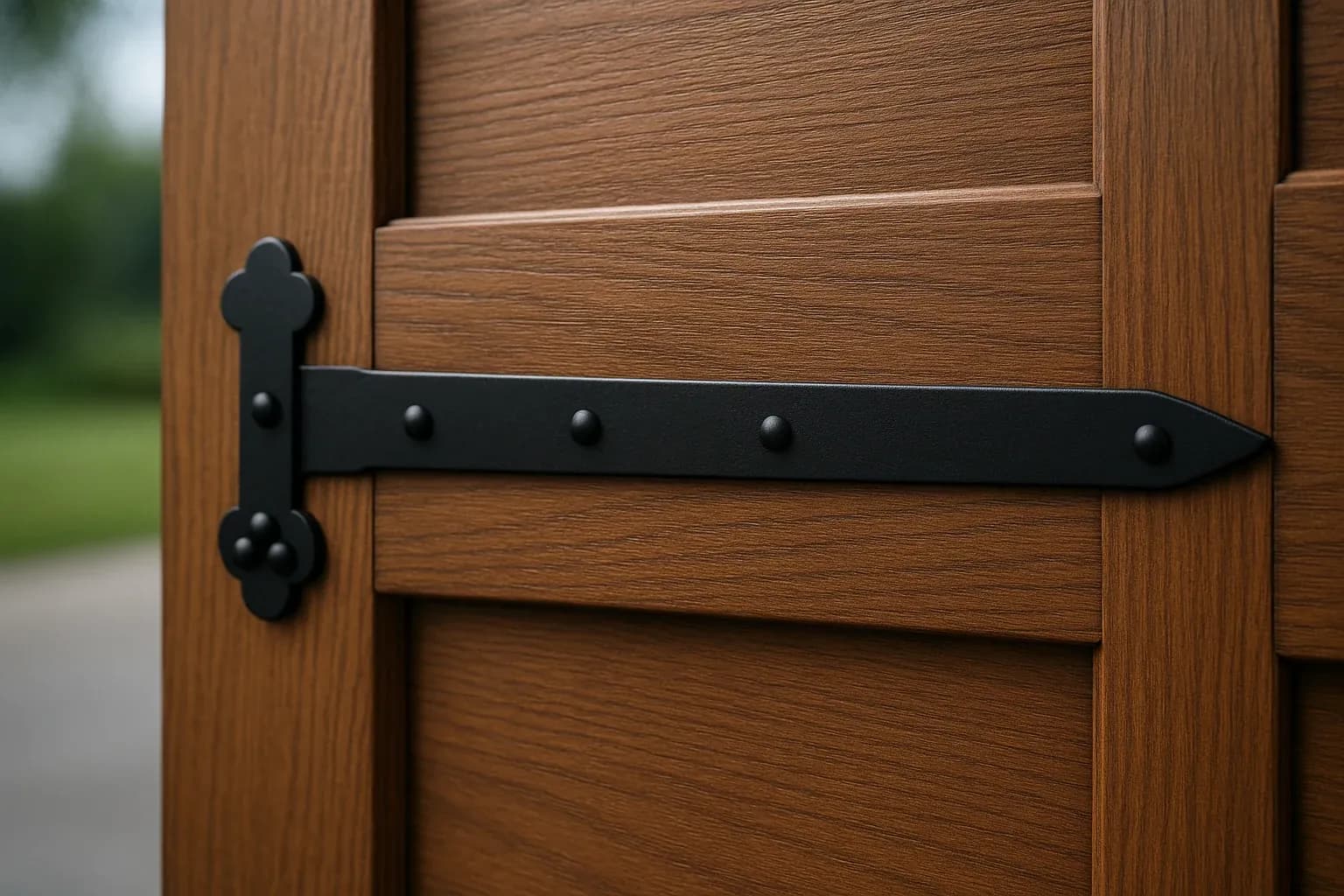
Strap hinges on a carriage-house garage door are decorative rather than functional — the door is still operated by the standard sectional door hardware at the panel joints. What makes decorative strap hinges look convincing is their weight, their attachment pattern, and their profile. Lightweight pressed-steel hinges with a painted finish look exactly like what they are. Heavier cast-iron or solid wrought-iron hinges with a hand-rubbed or powder-coated finish have a visual mass and surface character that reads as authentic. The difference in cost between a full hardware set in pressed steel versus cast iron is typically $150 to $300 for a double-car door. The visual upgrade is proportionally much larger than the cost difference.
Matching the hardware finish to the climate matters on the surrounding region, where ocean proximity affects how quickly ferrous hardware corrodes. Raw cast iron without protective coating will develop surface rust within a season in coastal Marshfield or Duxbury. Powder-coated cast iron holds up significantly better; oil-rubbed bronze and matte black powder coat are both durable choices that do not show surface oxidation in the same way. Stainless-steel hardware is available in some carriage-house lines and eliminates the corrosion concern entirely, though the appearance of stainless reads as more contemporary than the aged-iron aesthetic that suits colonial and federal homes.
Hardware scale relative to the door matters as much as finish. A decorative strap hinge that is proportioned for a smaller single-car door looks visually lightweight on a full sixteen-foot double-car door. Manufacturers produce hardware lines in coordinated scale — single-door scale and double-door scale — and confirming that the hardware selected is appropriately proportioned for the door width is a step that is easily skipped when ordering from a catalog photograph.
Matching style to architecture: colonial, federal, cape, and contemporary farmhouse
The communities on the surrounding region where carriage-house doors sell most strongly — Sherborn, Dover, Medfield, Holliston — contain a disproportionate share of homes built in or inspired by the colonial and federal vernacular. These architectural traditions share certain visual logic: symmetry, vertical proportion in window and door openings, restrained ornamentation. The carriage-house door styles that fit these homes best honor the same logic. Vertically proportioned window panels, a z-brace or x-brace pattern that reads as structural rather than decorative, and hardware finished in oil-rubbed bronze or matte black all align with the colonial and federal palette.
Cape-style homes present a slightly different challenge. The lower roofline and horizontal proportions of a cape mean that a garage door with strongly vertical window panels can feel out of scale with the overall facade. Carriage-house styles with horizontal window arrangements — two rows of shorter lights rather than one row of tall lights — tend to read better on cape-proportioned garages. The hardware choice can stay the same, but the window configuration should respond to the architectural proportions of the specific house.
Contemporary farmhouse homes — a style that has become increasingly common in new construction and renovation across the surrounding region over the past decade — open up additional options. The contemporary farmhouse aesthetic allows for mixed signals: modern proportions alongside traditional materials, clean lines alongside period hardware. For these homes, a steel-with-overlay carriage-house door in a matte black or dark charcoal finish with black powder-coated hardware reads as architecturally current while maintaining the carriage-house reference. This combination is among the best-selling configurations for contemporary farmhouse new construction in the Medfield and Holliston markets.
Cost premium, durability, and the long-term value case
Carriage-house styling carries a premium over standard raised-panel steel doors at every material tier. For a standard sixteen-foot double-car opening on a the surrounding region colonial, the cost comparison runs roughly as follows: a standard raised-panel insulated steel door installs in the $1,400 to $2,200 range. A steel-with-overlay carriage-house door at the same opening typically runs $2,800 to $4,200. A wood-look composite carriage-house door runs $3,500 to $5,500. A real wood carriage-house door from a quality manufacturer starts at $4,500 and can reach $8,000 or more for fully custom-built options with architectural-grade timber.
The durability tradeoffs across these tiers have been discussed above, but there is a value dimension beyond durability that the cost comparison does not capture: the effect of a carriage-house door on the overall curb appeal and perceived value of the home. In the surrounding region communities where this style is architecturally appropriate, an appropriate carriage-house door on a colonial or federal-style home contributes to resale value in a way that a generic raised-panel steel door does not. The door is the single largest architectural element visible from the street on most suburban homes; what it communicates about the quality of the renovation matters to buyers.
The maintenance commitment is where many homeowners underestimate the full cost of a real wood door choice. The door itself may cost $5,000 installed. A refinishing cycle every four years — sanding, priming, finish coats, hardware removal and reinstallation — runs $600 to $1,200 depending on the paint system and the contractor. Over a twenty-year period, the real wood door that cost $5,000 at installation will require $3,000 to $6,000 in finish maintenance, in addition to any panel repair or hardware replacement. The composite and steel-with-overlay alternatives require periodic inspection and seal maintenance but not the full refinishing commitment that real wood demands in this climate.
Frequently asked questions
What is the difference between a carriage-house style door and a farmhouse style door?
The terms overlap significantly in the marketplace. A carriage-house style door is characterized by surface details that evoke the appearance of hinged barn or carriage-house doors — z-brace or x-brace overlays, divided-light window arrangements, and strap hinge hardware. Farmhouse style is a broader aesthetic category that includes carriage-house styling but may also encompass plank-and-batten surface treatments, board-form panel arrangements, and matte-finish color palettes associated with contemporary farmhouse architecture. In practice, most manufacturers use the terms interchangeably for doors that combine traditional surface detailing with period hardware. The architectural fit depends on the specific home's style rather than which label the manufacturer applies.
How does real wood perform over time in a coastal the surrounding region climate?
Real wood garage doors on the surrounding region require more active maintenance than in drier inland climates. The combination of humidity, salt air, and significant seasonal temperature swings accelerates finish degradation and panel movement. A wood door with a high-quality penetrating oil or film-forming finish, maintained on a three-to-four-year recoating schedule, can perform well for twenty or more years. A wood door that receives inconsistent maintenance will show joint separation, paint failure at panel edges, and eventual wood rot at the bottom rail within eight to twelve years. The maintenance commitment is the primary variable — the wood itself is not inherently unsuited to the climate if it is properly protected.
Can a carriage-house door be added to a home that was built with a standard raised-panel door?
In almost all cases, yes. The carriage-house door installs on the same standard sectional door track hardware and header clearance that a standard raised-panel door uses. No structural modification to the garage opening is required. The hardware that drives the door — springs, cables, opener — is sized to the door weight, and a heavier real-wood carriage-house door may require a hardware upgrade if the existing springs were sized for a lighter door. A technician can assess whether the existing hardware is adequate for the door being installed as part of the installation process.