
Why your garage door reverses unexpectedly: safety sensors, beam alignment, and the law
BSD Garage Door
The UL 325 standard and why photoelectric sensors exist on every modern opener
The photoelectric safety sensor system on a residential garage door opener is not a manufacturer feature or a brand differentiator. It is a federal safety requirement that became mandatory for all residential garage door openers sold in the United States beginning in January 1993, under the UL 325 standard developed by Underwriters Laboratories. Before that standard took effect, residential garage door openers relied primarily on a mechanical auto-reversal system — a mechanism that detected physical resistance during closing and reversed the door. That reversal required the obstruction to physically contact the door bottom, meaning the door had already struck whatever was in its path before the reversal triggered.
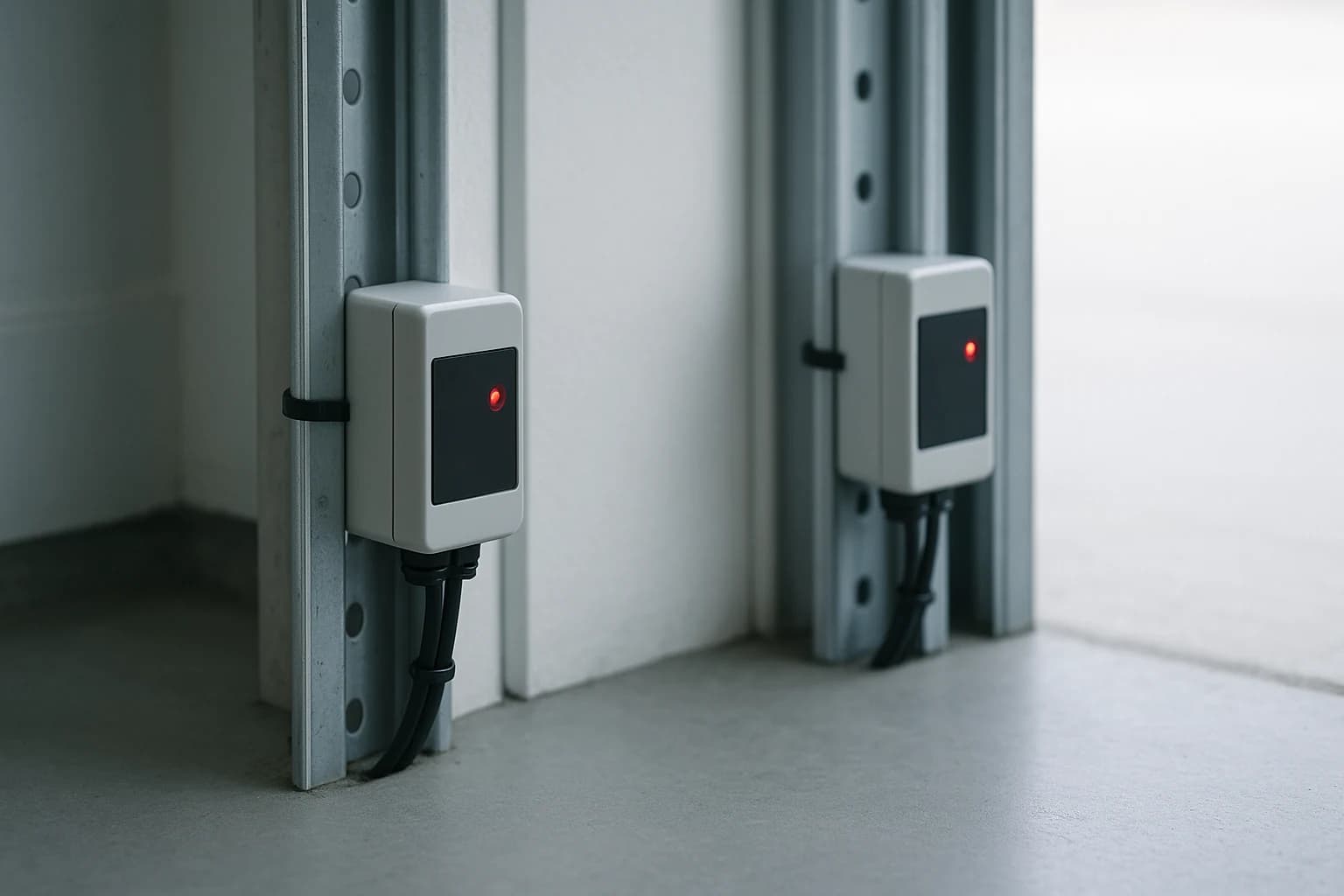
The impetus for UL 325's photoelectric sensor requirement was a documented pattern of injuries and deaths, predominantly involving young children, caused by garage doors that reversed too slowly or not at all when a person was in the closing path. The photoelectric beam — a pair of sensors positioned no higher than six inches above the floor on each side of the door opening, generating an invisible beam across the full width of the opening — detects any object in the path before the door contacts it. Interruption of the beam stops and reverses the door without any physical contact.
Every residential garage door opener manufactured and sold in the United States after 1993 is required to include a functioning photoelectric sensor system as a condition of UL listing. An opener without a functioning sensor system is not UL-listed for residential use. The sensor requirement applies to the opener system as sold; if sensors are removed, disabled, or bypassed after installation, the opener is no longer operating in compliance with the standard under which it was listed.
Understanding this history matters for the diagnostic conversation about unexpected reversal because it explains why the sensor system is not a problem to be routed around. The beam interruption that causes unexpected reversal is doing what it is designed to do: detecting a condition in the door travel path that should prevent closing. The goal of diagnosis is to find and correct that condition, not to defeat the detection.
How the photoelectric sensor pair functions
The sensor system consists of two components: a transmitter and a receiver. The transmitter, typically identified by an amber LED, emits a continuous narrow infrared beam toward the receiver on the opposite side of the door opening. The receiver, typically identified by a green LED when the beam is unobstructed, monitors for that beam continuously. When the beam is unobstructed, the receiver sends a signal to the opener's logic board indicating that the closing path is clear. When the beam is interrupted — by an object, a misalignment, or an electrical fault — the receiver signal changes, and the opener logic board registers a beam-break condition.
Under normal closing operation, the opener sends the door downward while continuously monitoring the beam status. If the beam-break signal occurs at any point during the closing travel — before the door bottom reaches the floor — the opener stops the closing motion and reverses the door upward. The reversal is immediate rather than graduated: the door does not slow and then reverse, it transitions from closing to opening as quickly as the motor direction can switch, which is typically within one to two seconds.
On most current-generation openers, the LED indicators on the sensors provide diagnostic information by their state. A solid green on the receiver and solid amber on the transmitter indicates that the beam is aligned, unobstructed, and functioning. A blinking green on the receiver typically indicates a beam alignment problem — the beam is misaligned enough that the receiver is not reading a consistent signal. A blinking amber on the transmitter indicates a wiring problem at the transmitter. On many Chamberlain, LiftMaster, and Genie openers, the number of times the opener's light flashes during a failed close attempt encodes a fault code that identifies the specific sensor fault type; this code is documented in the opener's owner manual and can significantly narrow the diagnostic field.
The sensor mounting height — no higher than six inches above the floor — is also specified by UL 325. This positioning is intentional: the beam must intercept objects at the lowest point in the door travel path, where a person lying or crawling in the path, or a small child, would be present. Sensors mounted higher than six inches may fail to detect low-profile obstructions and would not meet the standard.
The most common causes of unexplained reversal and what each indicates
Sensor misalignment from a bumped wall mount is the most frequently identified cause of intermittent reversal in service calls. The sensor mounting brackets are typically adjustable to allow the sensors to be aimed directly at each other, but they hold position only by friction or a single wing-bolt. A lawn mower handle, a bicycle tire, a hose cart, or any object stored in the garage that makes contact with the sensor bracket can shift the aim enough to produce beam interruption during closing. The symptom is consistent: the door reverses at the same point in its travel every time, because the misalignment is causing beam interruption that is predictable rather than intermittent. Realigning the brackets — confirmed by solid green on both sensors — resolves the reversal without any component replacement.
Sun glare on the receiver is a well-documented seasonal and time-of-day cause of reversal that is often not recognized immediately because it is intermittent and time-dependent. The receiver's photoelectric element is sensitive to infrared light, and direct or reflected sunlight entering the garage when the door is open and the sensor is in the closing path can saturate the receiver and cause it to read a beam-break condition even when the transmitter beam is present. This failure mode is most common in east- or west-facing garages in the late afternoon or early morning when the sun angle is low. The symptom is a door that reverses reliably at a specific time of day or season but operates normally otherwise. Repositioning the receiver slightly or adding a shroud to reduce direct light incidence on the receiver lens addresses the condition.
Spider webs, insect nests, and accumulated dust across the beam path are less intuitive but surprisingly common causes of beam interruption, particularly in garages that are not frequently cleaned. A spider web strung across the six-inch gap between the floor and the sensor beam height can scatter the beam enough to produce intermittent interruption. Moth infestations near the sensor in late summer, or accumulated cobwebs at the track base near the sensor mounting, are seasonal causes of intermittent reversal. Cleaning the sensor lenses and the immediate area around the sensor mounts typically eliminates the condition.
Water condensation on sensor lenses occurs in the the Northeast climate during the transition seasons — late fall and early spring — when interior garage temperature and exterior temperature differ significantly and the door is opened to exterior air. Condensation on the transmitter lens scatters the outgoing beam; condensation on the receiver lens reduces its sensitivity. In both cases the effect is a weaker or interrupted beam signal. This is typically a transient condition that resolves as the garage temperature equilibrates, but it can cause recurring morning reversal problems in garages with poor vapor sealing. Drying the lenses with a cloth resolves the immediate issue; reducing condensation through better garage sealing addresses the recurrence.
Frayed or damaged wiring from the opener unit to the sensors is a less common but more persistent cause of sensor failure. The sensor wires run along the door track and down to the sensor brackets, typically stapled or clipped to the track. Over years of vibration from door cycling, the wire insulation at the staple points can wear through and produce intermittent shorts or open circuits. Wiring damage is more common on older systems where the wire has been in place for ten or more years. The symptom is often inconsistent — the door sometimes reverses and sometimes does not — because the fault is position-dependent and the wire makes and breaks contact as the track vibrates during operation. A technician will test continuity from the opener unit to both sensors to identify wire faults.
Sensor versus separate failure: reading the symptom pattern
Not every unexpected reversal involves the photoelectric sensors. Garage door openers have a separate mechanical auto-reversal system — a force-sensing circuit that triggers reversal when the opener motor encounters more resistance than its force settings allow during closing. This system is calibrated to the weight and balance of the specific door, and if the door is out of balance, has friction in the track, or has a spring that is beginning to lose tension, the force-sensing system may trigger reversal even when the beam is unobstructed.
Distinguishing sensor reversal from force-sensing reversal requires observing the door's behavior in detail. If the reversal occurs consistently at the same height above the floor — particularly near the bottom of the travel, where the door is heaviest relative to the spring counterbalance — and the sensor LED indicators show a solid green alignment, the force-sensing system is the more likely cause. This typically indicates a door balance problem, a friction point in the track or hardware, or a spring that is approaching the end of its service life. If the reversal occurs at random points in the travel and the sensor indicators are not consistently showing solid alignment, the sensor system is the more probable cause.
The opener's self-diagnostic flash codes, where available, are the most direct way to identify which system is triggering reversal. A flash code indicating a sensor fault directs the diagnosis to the photoelectric system; a flash code indicating a force limit or travel limit issue directs it to the mechanical and balance systems. Accessing the flash code interpretation requires the opener model number, which is typically on a label on the opener motor unit.
- Sensor LED not solid green: beam alignment or obstruction issue — diagnose sensor system before any other component
- Reversal at consistent point in travel, sensors aligned: force-sensing or balance issue — check spring tension and track friction
- Reversal intermittent, time-of-day dependent: suspect sun glare on receiver
- Reversal after physical contact with sensor area: check sensor bracket alignment first
- Opener LED blinks after failed close: count blinks and look up fault code in owner manual
Why bypassing or disabling sensors is illegal and dangerous
The question of bypassing the photoelectric sensor system to stop unwanted reversals arises in service calls when the diagnostic cause is not immediately apparent or when the sensor hardware is not locally available for immediate replacement. The answer is unambiguous: bypassing or permanently disabling the photoelectric sensor system on a residential garage door opener is illegal in the United States and is a documented safety hazard.
Under UL 325, the photoelectric sensor system is an entrapment protection device. An opener operating without functioning entrapment protection does not meet the UL listing requirements under which it was certified. More directly, operating an opener without entrapment protection in a residential garage creates the specific hazard that the 1993 standard was enacted to prevent. The historical record of injuries and fatalities that preceded UL 325 is not a historical curiosity; it documents what happens when the entrapment protection system is absent.
Beyond the safety dimension, bypassing the sensor system creates liability exposure for any property owner who does so. If a person is injured by a garage door operating without functional entrapment protection, the absence of that protection is not a mitigating fact for the property owner. It is a direct indicator of failure to maintain a required safety system.
The correct response to a sensor system that causes unwanted reversal is to identify and correct the cause of the beam interruption, not to remove the detection capability. In the overwhelming majority of cases, the cause of unwanted reversal in a properly installed sensor system is a correctable environmental or alignment condition — not a sensor failure requiring bypass. When a sensor unit has genuinely failed and requires replacement, the replacement sensor units are the appropriate response. Sensor replacement hardware for the major opener brands is widely available and straightforward to install.
When a sensor assembly is due for replacement
Photoelectric sensor units have a finite service life, though they are generally robust components that outlast many other opener system parts. The indicators that a sensor unit itself has failed — rather than that the system has an alignment, obstruction, or wiring issue — include persistent LED fault indications that do not respond to alignment correction, intermittent LED behavior that is not consistent with any environmental cause, and physical damage to the sensor housing or lens that has allowed moisture or debris entry.
Sensor units that are more than fifteen years old and are showing consistent alignment difficulty despite correct bracket positioning may have experienced degradation of the photoelectric element that reduces sensitivity to the point where alignment is difficult to maintain. This degradation is accelerated in garages with high humidity cycles, significant temperature variation, or dusty environments. In these cases, sensor replacement — rather than continued alignment adjustment — is the practical resolution.
Sensor replacement on most residential opener systems involves disconnecting the wiring from the old sensor units, removing the brackets, mounting the new sensor brackets at the same positions, routing the sensor wires, and confirming alignment with the LED indicators. The replacement units for the major opener brands — LiftMaster, Chamberlain, Genie, Craftsman — are readily available and the process is not technically complex. What requires care is the wiring connection and the precise six-inch-maximum mounting height, both of which affect UL 325 compliance of the completed installation.
Frequently asked questions
My garage door only reverses when it rains or in cold weather. Is that a sensor problem?
Weather-dependent reversal that correlates with rain or cold most commonly points to one of three causes: moisture condensation on the sensor lenses (which scatters the beam), water intrusion into the sensor wiring at a damaged insulation point (which can cause intermittent short circuits), or cold-induced contraction of the door hardware that increases closing resistance enough to trigger the force-sensing auto-reversal. The distinction matters for diagnosis: if the sensor LEDs show normal alignment during the reversal event, the force-sensing system is the likely cause, and the focus shifts to door balance and hardware condition. If the LEDs are showing a fault during the reversal, the sensor wiring and lenses are the starting point.
My opener is from the late 1990s and has sensors, but I bought a used home and I don't know if they work properly. How should I test them?
The standard functional test for photoelectric sensors involves waving an object — a rolled-up newspaper, a broom handle — through the sensor beam path while the door is actively closing. If the sensors are functioning, the door should stop and reverse before the object is contacted by the door bottom. The sensors should also be tested for alignment: the receiver LED should be solid green (not blinking) when the door is open and the sensor pair is unobstructed. If the receiver LED is blinking, the beam is not aligned or is being interrupted, and the door should not be used for regular operation until the cause is identified and corrected. For a system of unknown service history, a professional inspection of the sensor wiring, bracket condition, and opener safety functions is a reasonable starting point.
My neighbor said I can disconnect the sensors because they're causing too many problems. Is that true?
No. Disconnecting the photoelectric safety sensors on a residential garage door opener is not a legal or safe response to nuisance reversal. The sensors exist to prevent the door from striking a person, child, or animal in the closing path. Removing the entrapment protection to eliminate the inconvenience of unexpected reversal trades a manageable diagnostic problem for an ongoing physical hazard. The correct path is to identify why the sensors are causing reversal — alignment, obstruction, wiring, environmental — and correct the underlying condition. In the large majority of cases, the cause is identifiable and correctable without component replacement.