
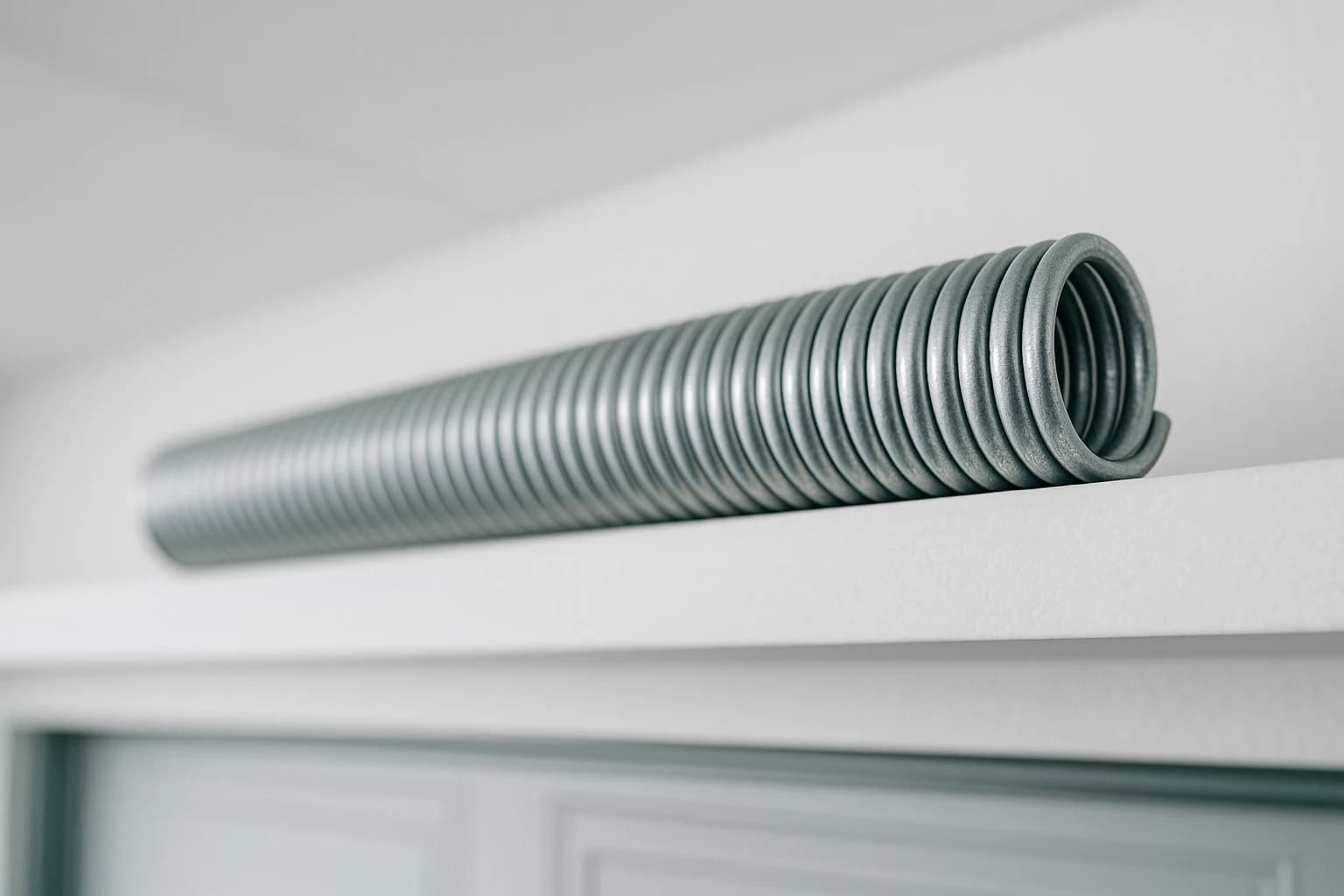
How garage door springs really work — and why stored energy makes them dangerous to handle
BSD Garage Door
The mechanical problem a garage door spring solves
A standard residential sectional garage door weighs between 150 and 400 pounds depending on panel material, door size, and insulation tier. A basic 16-foot two-car steel door without insulation weighs roughly 150 to 180 pounds. An insulated triple-layer steel door at the same size runs 200 to 260 pounds. A solid wood carriage-house door at full size can reach 300 to 400 pounds. The garage door opener motor — the electric unit that most homeowners identify as what opens the door — provides 1/2 to 3/4 horsepower of drive. That motor alone cannot lift 200 pounds repeatedly without overheating and failing within months.
The spring system solves this problem by counterbalancing the door's weight. A properly tensioned spring system stores potential energy when the door closes and releases that energy when the door opens, effectively canceling out most of the door's gravitational load. The opener motor then needs to move only the residual unbalanced weight — typically 10 to 20 pounds on a well-adjusted system — rather than the full dead weight of the door. This is why a properly balanced garage door can be lifted manually with one hand: the springs are doing the work; the human or the opener motor is only guiding the motion.
There are two fundamentally different spring architectures used in residential garage doors: torsion springs and extension springs. Each stores energy in a different physical form, each has different failure modes, and each requires different service approaches. Understanding the distinction between them explains why spring work carries the specific risks it does — and why those risks are not comparable to the risks of most other home maintenance tasks.
Torsion springs: torque, winding, and stored rotational energy
A torsion spring in a garage door system is a coiled steel spring mounted on a horizontal steel shaft that runs across the full width of the door opening, just above the door in its closed position. The spring is wound — pre-tensioned by rotating it a specific number of turns around the shaft — before the door is installed. This winding process creates rotational tension in the coil: the spring wants to unwind and will do so with significant force if given the opportunity. A fully wound torsion spring stores rotational energy in the form of torque — the tendency to produce rotation around the shaft's axis.
The amount of torque stored depends on the spring's physical properties: the wire diameter, the coil diameter, and the number of active coils, combined with the number of turns applied during winding. These parameters are calculated during the design phase to match the spring's output to the door's weight and the geometry of the cable drum system that translates the spring's rotation into linear cable movement. The spring wire itself is made from hardened steel with a very high yield strength — it can deform significantly under load without taking a permanent set. This is what allows it to go through tens of thousands of cycles before fatigue cracking eventually causes failure.
The torque stored in a fully wound residential torsion spring ranges from roughly 25 to more than 60 pound-feet depending on the door weight and the spring specification. To put that in physical terms: a torque of 50 pound-feet applied to an 18-inch winding bar — the tool used to add tension to a torsion spring — produces 400 pounds of force at the end of the bar. The spring does not care whether the object at the end of that bar is a winding tool or a human hand. This is the physical reality that defines why an unwinding or failing torsion spring is capable of causing severe injuries. The energy is not chemical or thermal; it is purely mechanical, stored in the steel of the spring, and it releases at the speed of steel movement rather than at any speed a human can react to.
Extension springs: tension, travel distance, and the cable-failure hazard
Extension springs work on a different mechanical principle. Rather than storing energy through rotation, extension springs store energy through elastic elongation — they are stretched beyond their resting length when the door closes, and they release that stored tension when the door opens. Extension springs run horizontally above the door track sections on each side of the garage, parallel to the horizontal track rails. They are connected by cables that run from the spring to a pulley at the front of the track and then down to the bottom bracket of the door.
The tension in a fully loaded extension spring on a residential door falls in the range of 150 to 300 pounds of pull force per spring. On a two-spring extension system, the total stored force across both springs can reach 400 to 600 pounds. When this force is released suddenly — through spring fracture or cable failure — it has to go somewhere. The spring itself can whip violently within the garage space. This is why extension spring installations require a safety cable threaded through the center of each spring: the cable contains the spring if it fractures, limiting the flight range of the broken spring halves to the length of the safety cable rather than allowing them to travel freely across the garage interior.
Cable failure in an extension spring system produces an asymmetric loading condition that is distinct from torsion spring failure. When one side of a dual-extension system loses its cable, the remaining spring and cable on the opposite side continues to pull. The door does not simply drop straight down — it experiences a twisting force that attempts to rotate it within the track, loading the rollers and track brackets on the intact side asymmetrically. This can bend the vertical track sections, derail rollers, or crack panel hinge points, depending on which cable fails and how quickly the door is moving at the moment of failure. The asymmetric whip motion is a secondary hazard beyond the spring release itself.
- Torsion spring: stores energy as rotational torque; mounts on a shaft above the door header; releases as shaft rotation translated to cable drum movement
- Extension spring: stores energy as elastic tension; runs parallel to horizontal track sections; releases as linear pull force through the cable-and-pulley system
- Safety cable: required through extension spring center; limits spring travel path if the coil fractures mid-span
- Cable failure asymmetry: a broken extension spring cable creates uneven loading; the door twists rather than dropping straight, stressing track and hardware on the intact side
Why springs are sold and installed as matched pairs
Residential torsion spring systems commonly use two springs on a single shaft rather than one. This is not redundancy — the pair is not designed so that one spring can function if the other fails. The two springs are a matched set designed to share the load equally, each contributing approximately half the total required counterbalance torque. They are matched by wire diameter, coil diameter, and length, and both are wound to the same number of turns during installation.
The reason both springs should be replaced when one fails is the fatigue state of the surviving spring. A torsion spring has a rated cycle life — typically 10,000 to 30,000 cycles depending on the wire diameter and spring type, with higher-wire-diameter springs lasting significantly longer. The two springs on a paired system are installed at the same time and have accumulated the same number of fatigue cycles. When one spring fractures, the other spring is at the same fatigue state, meaning it will likely fail within a similar number of additional cycles — sometimes within days or weeks if it is near end-of-life. Replacing only the failed spring leaves the system with one new spring and one spring that is near the end of its rated life. The asymmetric tension state this creates — because a new spring and an aged spring do not produce identical torque at identical wind levels — also creates a door that is not evenly balanced, which places lateral loads on the opener trolley and the cable drums.
The same matched-pair logic applies to extension springs, where the tension on both sides of the door must be equal for the door to travel straight in its tracks. An extension spring that has accumulated significant cycle wear will have a slightly different spring constant than a new spring, meaning the two sides of the door will pull unequally even when the springs are set to nominally identical lengths. Replacing both springs at the same time is not an upsell; it is the technically correct response to a spring failure on any system where two springs share the counterbalance load.
Documented injury patterns and what they reveal about the risk
The U.S. Consumer Product Safety Commission estimates that garage door mechanisms — including springs, cables, and the door itself — account for tens of thousands of emergency room visits annually in the United States. Spring-related injuries represent a specific subset of this total that is qualitatively different from the pinch-point and crush injuries associated with the door itself. Spring injuries tend to be high-energy events: fracturing springs or suddenly released tension cables produce impacts comparable in force to blunt trauma from heavy tools striking at high velocity. The injury patterns include lacerations from broken spring wire, blunt trauma from spring components contacting the body during release, and secondary injuries from falling door sections when the counterbalance is suddenly lost.
What the injury data reflects about the risk is not simply that springs are dangerous in the abstract sense that many home maintenance tasks carry some risk. The specific hazard is that a spring under full tension can release its entire stored energy in a fraction of a second, with no warning signal and no opportunity for an observer to react. A wood screw that is over-tightened will strip gradually. A ladder that is improperly positioned will shift before it falls. A torsion spring that reaches the end of its fatigue life fails instantaneously — the coil cracks and the spring unwinds with the full stored torque before the human nervous system has time to register that something has changed.
This is the core reason spring work is categorically different from the kind of maintenance task that a careful, mechanically skilled homeowner can safely perform. The hazard is not primarily about technique or knowledge — it is about the physics of energy release speed. The spring does not care about the skill level of the person nearby when it fails. This is also why explaining the danger is genuinely useful: homeowners who understand that the spring is storing 50 pound-feet of torque under active tension — not that it is merely "under pressure" in some vague sense — understand why proximity to a tensioned spring during adjustment or replacement is not comparable to other physical risks they navigate daily.
What a technician's training and tools actually address
A trained garage door technician approaches spring work with a specific set of tools, procedures, and situational awareness that are designed around the physics described above. The winding bars used to add or remove torsion on a torsion spring are rated tools — specific lengths and diameters designed to provide the mechanical advantage needed to control the winding process and to keep the technician's hands clear of the spring's winding cone. The length of a winding bar matters: a shorter bar requires more force to turn and keeps the hands closer to the spring. A longer bar requires less force and moves the hands farther from the energy release point.
The drum and cable system is always fully unloaded before any spring work begins. This is not an optional precaution — it is the sequence that allows the spring tension to be controlled and the work to be performed in a defined state rather than an unknown tension state. Confirming that the cables are fully slacked before touching the winding cone is the foundational step from which all spring work proceeds safely. A technician who skips this confirmation — for any reason — is working in an undefined tension state, which is where injuries occur.
The experience dimension in spring work is not primarily about knowing which direction to turn the winding bar. It is about reading the physical state of the system accurately before any tool contacts the spring hardware. A technician who has worked on several thousand spring systems knows what a cable that is nearly detached from its drum looks like, what a cable drum with a hairline crack in the casting feels like under lateral load, and what the winding cone threads feel like when they are about to strip. None of this knowledge is in a manual or a video. It accumulates through repetitive physical engagement with the system in controlled conditions, not through one-time encounters with a system that may be in an unknown state.
Frequently asked questions
How do I know if my torsion spring is near the end of its life before it breaks?
Torsion springs do not give reliable advance warning before fracture — this is part of what makes them hazardous. Some springs develop visible rust or surface corrosion that accelerates fatigue, and a technician can identify this during inspection. Springs with visibly corroded coils, coils with flat spots or distortion, or springs that show a gap between coils at one point on the shaft (indicating a previous partial fracture that propagated) are all signs of advanced wear. If the door is older than seven to ten years and the springs have never been replaced, a scheduled inspection is the appropriate response rather than waiting for a failure event.
What happens to the garage door if a spring breaks while the door is in motion?
The door does not immediately crash to the floor in most cases. Modern openers include a force-sensing cutoff that detects unexpected resistance and stops the drive mechanism. The door may stop mid-travel, may reverse, or may drop a few inches before the opener catches the load. However, with the spring counterbalance gone, the full weight of the door is now supported only by the opener trolley and the cable system. The door should not be operated in this condition — the opener was designed to move a balanced door, not to support the dead weight of a door that has lost its counterbalance. The correct response is to disconnect the opener, leave the door in its current position, and have the spring replaced before operating the door again.
Are some springs more durable than others, and is it worth upgrading?
Yes. The primary durability variable in torsion springs is wire diameter. A standard residential torsion spring uses wire in the 0.225 to 0.262 inch diameter range and is typically rated for 10,000 cycles. A heavier-wire spring — 0.273 to 0.295 inch diameter — is rated for 20,000 to 30,000 cycles. The heavier wire spring costs more at installation but extends the replacement interval significantly. For a door that cycles three to four times per day, a standard spring reaches its rated life in roughly seven to nine years. A high-cycle spring at the same usage rate may last fifteen to twenty years. The upgrade cost is typically $50 to $100 per spring above the standard specification — a reasonable investment for the extended service interval it delivers.