
When a garage door spring snaps: when repair makes sense and when replacement is the only call
BSD Garage Door
What happens mechanically when a spring breaks
A residential sectional garage door in standard configuration weighs between 130 and 250 pounds depending on door size, material, and insulation tier. That weight is not lifted by the opener motor — the motor is a modest device rated for light-duty cycling. The actual lifting force comes from the spring system, which stores and releases mechanical energy through coiled steel. The opener provides direction and control; the springs provide the counterbalance that makes a heavy door effectively weightless to move.
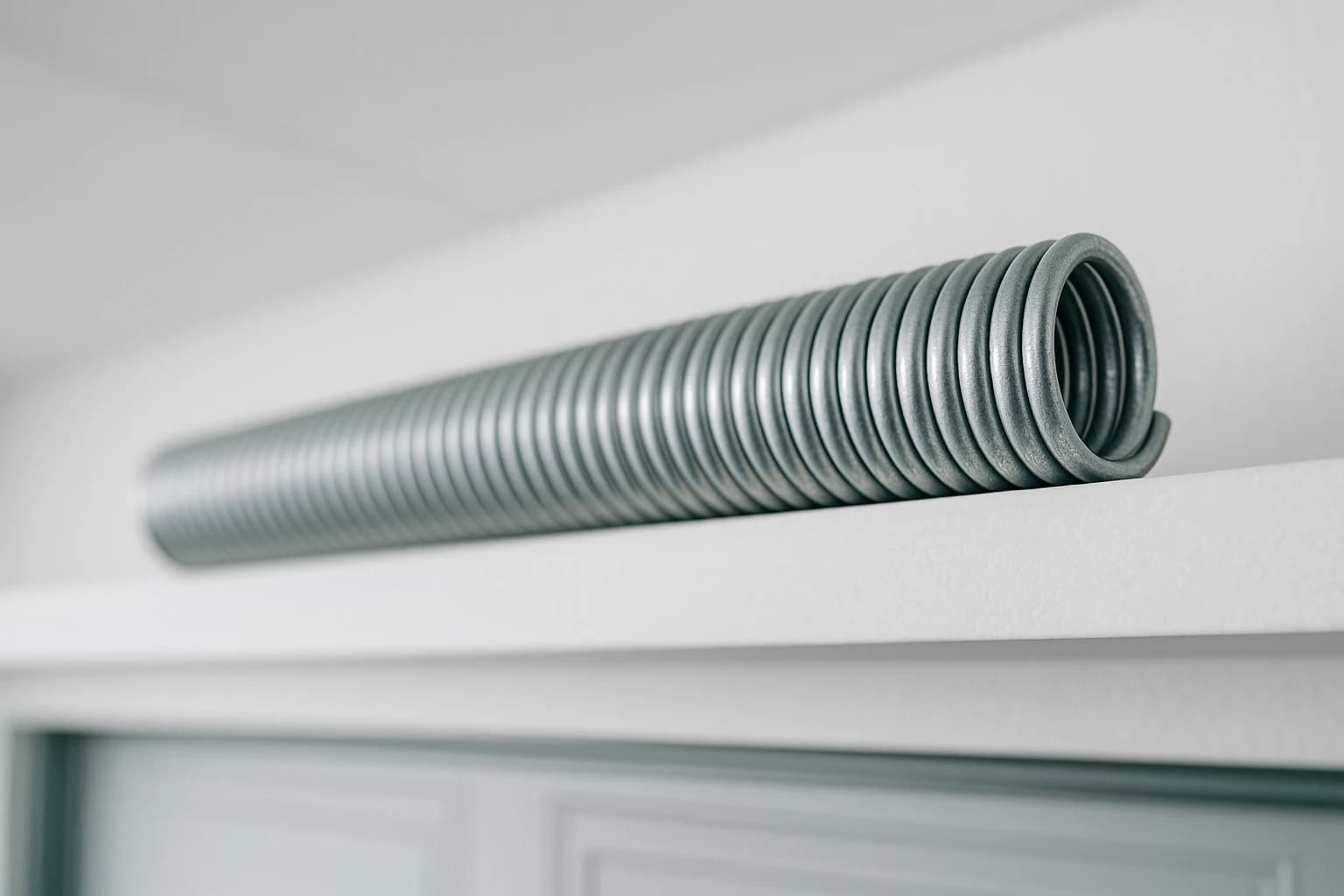
Torsion springs are the dominant configuration on modern sectional doors. A torsion spring mounts horizontally above the door opening on a steel shaft. As the door descends, the cable drums wind cable around themselves and simultaneously wind torque into the spring. When the door is raised, the spring releases that stored torque through the shaft and drums, paying cable out at a controlled rate that counterbalances the door's weight across its full travel arc. At the fully open position, the spring has transferred most of its stored energy; at the fully closed position, the spring is wound to its maximum torque load.
When a torsion spring fractures — typically at a stress concentration point mid-coil or near a winding cone — that stored energy releases instantaneously. On a properly installed system, the safety cables running through the center of the spring contain the fractured coil sections. The door drops to the floor under its own weight because the counterbalance is gone. The opener, sensing resistance it cannot overcome, either trips its clutch mechanism or simply stalls. The door is now mechanically inert regardless of what the opener does.
Extension springs, which run parallel to the horizontal track sections on older door configurations, store energy through elongation rather than torsion. When an extension spring breaks, the door-side cable on that track goes slack and the door drops or skews. Extension spring failures carry a distinct secondary hazard: the fractured spring section itself can travel several feet if a safety cable is not installed. This is a less common configuration on doors installed in the last fifteen years but remains prevalent in older garages.
Why spring replacement is not a solitary task
The stored-energy content of a properly wound torsion spring is not a small quantity. A standard residential torsion spring on a 16-foot double-car door weighing 200 pounds holds enough torsional energy at full wind to cause serious injury if a winding cone slips, a winding bar is released without control, or the spring is handled without proper tooling. The winding and unwinding procedure requires dedicated winding bars of specific length, a secure door in a known position, and the knowledge of exactly how many quarter-turns the spring requires for that specific door weight and spring specification.
There are no safe shortcuts in this procedure, and the consequences of an error are not recoverable. A winding bar ejected from a winding cone slot at speed moves faster than a reflexive response can manage. This is the reason that spring replacement is categorically not a homeowner task, regardless of mechanical ability or general home-repair competence. The hazard is not in the complexity of the steps — the steps are straightforward — it is in the physics of what happens when one of those steps goes wrong. Our crew handles spring work with tooling and procedures specifically matched to the task.
Beyond the safety dimension, spring work requires knowing the correct replacement specification. Torsion springs are characterized by wire diameter, inside diameter, and length, and the specific combination determines the torque constant that matches the door's weight and height. Installing a spring with an incorrect wire diameter — even one gauge off — produces a door that is either chronically over-wound (spring failure in months) or under-counterbalanced (opener motor overloaded on every cycle). Proper spring selection requires knowing the door weight, which is not marked anywhere on the door itself and must be calculated or measured.
Single spring versus matched-pair replacement
The question of whether to replace one spring or both is one of the most consequential decisions in a spring service call, and the answer depends on two factors: the spring configuration and the age of the springs.
On a door fitted with two torsion springs — the configuration used on most double-car doors because it distributes load more evenly — replacing only the broken spring and leaving the surviving spring in place creates an asymmetric failure risk. Both springs were installed at the same time and have accumulated the same cycle count. If one has broken under fatigue stress, the other is at or approaching the same point in its fatigue curve. A single replacement in this scenario typically returns the customer to the same failure mode within six to eighteen months on the second spring. Matched-pair replacement costs more upfront but eliminates the follow-up call and the second period of door inoperability.
On a single-spring torsion system — used on single-car doors and some lighter double-car doors — there is only one spring to replace, which simplifies the decision. The related question is whether to replace at the standard specification or upgrade to an extended-cycle spring.
A standard residential torsion spring is rated at 10,000 cycles. At two cycles per day — one opening and one closing — that is roughly 13 years of expected life under normal use. Extended-cycle springs rated at 20,000 or 30,000 cycles use heavier wire stock that tolerates the same torque with less stress per cycle, which extends fatigue life proportionally. The cost premium over a standard spring is modest — typically in the range of $40 to $80 per spring depending on specification — and for a household with four or more daily cycles, the upgrade materially extends the interval before the next failure. The upgrade conversation is always worth having at the time of replacement.
When the spring failure also means cable and drum work
A spring fracture does not always mean only the spring needs attention. The technician's assessment at arrival typically covers four components beyond the spring itself: the cables, the cable drums, the center bearing plate, and the end bearing plates.
Cables run from the bottom bracket at each side of the door up to the cable drums, which are mounted on the torsion shaft. Cables are steel wire rope under continuous load cycling. Fraying typically begins at the bottom bracket attachment point, where bending stress and moisture exposure combine. A cable that has been in service as long as the broken spring may be at a fraction of its rated tensile strength due to wire breaks that are not visible without close inspection. Replacing a spring and leaving a frayed cable in place transfers the failure risk from the spring to the cable — a cable snap under tension has its own set of hazards.
Cable drums are aluminum castings with machined cable grooves. Worn grooves cause cables to stack rather than wind in a controlled helix, which eventually causes the cable to jump the drum and go slack on one side. This produces a lopsided door that stresses tracks and rollers. Drum wear is a function of cycle count and lubrication history; drums on a door with broken springs at 10,000 cycles may show significant groove wear if they were never lubricated during their service life.
Center and end bearing plates support the torsion shaft at each mounting point. Worn bearings cause shaft wobble that accelerates spring wear at the attachment points. If the previous spring failure was at a winding cone rather than mid-coil, bearing wear is worth checking as a contributing factor. Addressing worn bearings at the time of spring replacement, rather than as a separate service call later, is the efficient path.
Cost framing for spring service decisions
Spring replacement costs fall into a fairly predictable range based on configuration. A single torsion spring replacement on a standard single-car door, including labor and parts, runs in the lower tier of garage door service costs. A matched-pair replacement on a double-car door runs roughly 1.5 to 1.8 times that figure. Upgrading from 10,000-cycle to 20,000-cycle springs within either configuration adds a modest increment — typically less than 20 percent of the total bill.
When cable replacement is added to the spring work, the incremental cost is relatively low because the labor overhead is shared — the technician is already in the spring work position, the door is already secured, and cable replacement adds one to two steps to a procedure already underway. Doing cable work as a separate visit later would duplicate the setup cost. This is why a bundled spring-plus-cables estimate, when cables show wear, almost always represents better value than sequential service calls.
The comparison point for any spring service decision is the cost of full door replacement. For a door that is fewer than ten years old with a spring failure in an otherwise sound system, spring and hardware service is the clear choice. For a door that is fifteen or more years old with degraded weather seals, aging rollers, and a spring failure, the arithmetic often favors full replacement — the hardware service cost approaches the incremental cost of a new door that resets all components simultaneously. The technician's assessment of overall door condition at the time of the spring call provides the information needed to make that comparison clearly.
What the door tells you before a spring fully breaks
Torsion springs rarely fail without warning signs, though the signs are easy to dismiss. A door that requires noticeably more force to lift manually than it used to — or that the opener handles with audible strain — is showing reduced spring counterbalance, which indicates a spring approaching the end of its fatigue life. The spring has not yet fractured, but the coil structure has begun to lose its torque constant due to accumulated micro-deformation.
A popping or cracking sound during door travel — distinct from the routine mechanical sounds of a properly lubricated door — sometimes precedes a spring break by days or weeks. This sound can be the spring under elevated stress as a crack propagates through the coil. It can also be unrelated to the spring. Either way, it warrants a technician's inspection before the failure becomes a door that will not move.
Visible corrosion on the spring coils is a direct indicator of reduced fatigue life. Salt air, humidity, and thermal cycling accelerate corrosion at the coil surface, which reduces the effective cross-section of the wire and concentrates stress at pitted points. A spring with significant surface rust may fail well before its rated cycle count. Annual visual inspection of the spring system — accessible from inside the garage with the door in the closed position — takes less than a minute and can catch this condition before it becomes a service emergency.
Frequently asked questions
Is it safe to manually operate the door with a broken spring?
Technically possible but not advisable. With the spring broken, the door has no counterbalance, which means the full door weight — potentially 150 to 250 pounds — must be managed entirely by whoever is lifting it. The door can also descend rapidly and unexpectedly if grip is lost. If the door must be moved before service, disconnect the opener, use two people, and keep fingers and feet clear of the door's path. Do not leave the door in the open position unsupported — secure it with a locking pliers clamped to the track below a roller to prevent it from descending.
What is the difference between a 10,000-cycle and a 20,000-cycle spring in practical terms?
A 20,000-cycle spring uses heavier gauge wire to achieve the same torque constant with less stress per cycle. For a household averaging two to three door cycles per day, the standard 10,000-cycle spring yields roughly 10 to 14 years of service life. The 20,000-cycle upgrade yields 20 to 28 years under the same usage. For a four- to six-cycle household — common with multiple drivers or frequent deliveries — the math shifts the practical service interval from 5 to 7 years on a standard spring to 10 to 14 years on the upgrade. The premium for this extension is modest relative to the service call cost it eliminates.
Does a spring failure void the opener warranty?
Spring failure itself does not void the opener warranty, but a prolonged period of operating the opener against an improperly counterbalanced door — which occurs when a spring has been weakening for months before it breaks — can cause cumulative damage to the opener's motor and drive system that the warranty may not cover. Opener warranties typically cover manufacturer defects, not damage caused by operating conditions outside design parameters. Keeping the spring system properly maintained protects both the spring and the opener.
How long does a spring replacement take?
A standard single-spring replacement on a straightforward residential torsion system takes approximately 45 to 75 minutes from arrival to departure, including assessment, parts verification, replacement, tension setting, and door balance testing. A matched-pair replacement runs 60 to 90 minutes. If cable or drum work is added, total time increases by 20 to 40 minutes depending on the extent of the additional work. The door is fully operational at the end of the visit — there is no curing time or settling period required.